




Listen to the full episode now:
Key Takeaways
- An MVP website is still your brand’s cornerstone digital asset, and it deserves real strategy, not just a template.
- AI tools are genuinely great for speed, but “MVP” still means viable. Skip the strategy work (accessibility, performance, brand messaging, content flow), and you’ve built something that isn’t ready for market, not something minimum.
- The signal that you’ve outgrown your MVP site: when your website needs to start doing something for you instead of just representing you, like capturing leads, running customer service, or powering operations.
- Workhorse’s new division, Ignite, brings enterprise-level strategy to small business budgets, so you don’t need a $50K build (or an IPO) to get a website that works.
Every business starts somewhere on a spectrum. On one end: a brochure site that tells people who you are. On the other: a full-blown enterprise system running your operations. Most businesses live somewhere in the middle, and most of them have no idea where.
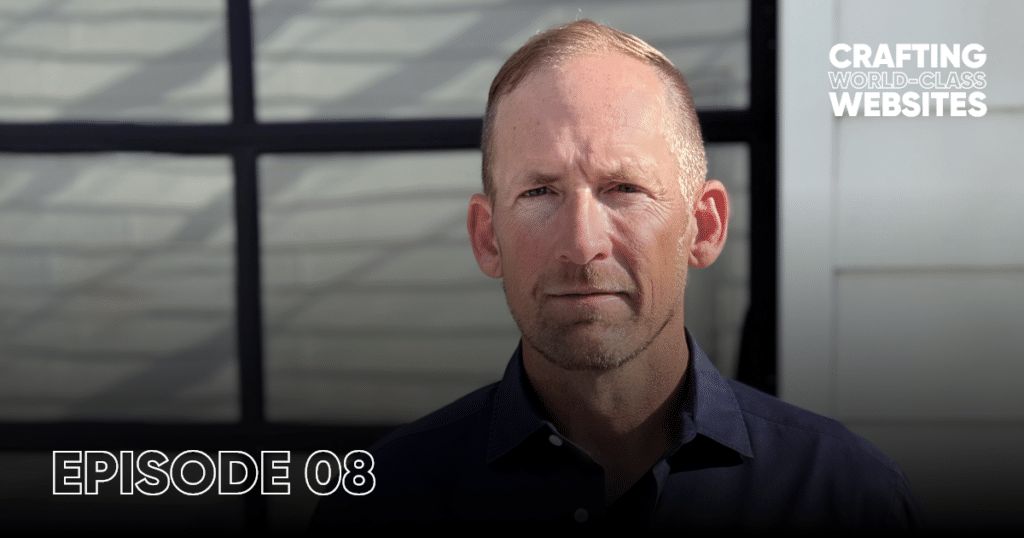
We sat down with Workhorse founder and CEO Grant Chambers, who’s spent over 20 years watching businesses move along that exact spectrum, to talk about what an MVP website actually needs, when you’ve outgrown it, and why the current wave of AI tools changes less about that math than you’d think.
MVP Doesn’t Mean Minimum Effort
First, let’s kill a common misconception here: “MVP website” might be used interchangeably with “starter site” or “simple site.” And that’s fine, but it doesn’t mean an MVP site is unfinished. It’s not an afterthought.
“An MVP website is low-tech,” Grant explains. “For a lot of businesses, maybe this is a 10-pager that showcases the brand, services, products, the team, so on and so forth.”
But he’s also quick to add an important caveat: “MVP websites are still extremely important, and they should be built strategically; they should be optimized, because it’s still the brand’s cornerstone digital asset.”
That’s the point here: Whether it’s your first website or your tenth redesign, it’s still your front door on the web. It still needs to clearly communicate your value and make prospective customers want to work with you. A site being simple doesn’t excuse it from being good.
So When Do You Outgrow It?
But as businesses grow, they will inevitably outgrow the MVP site. Most people notice it as a gradual progression: You don’t wake up one day with an enterprise-sized problem. You just start noticing friction.
“When you start reaching those points where you feel like, ‘Oh, I wish my website did this,’ or ‘It said this,’ then maybe your needs are becoming a little more dynamic, a little more sophisticated,” Grant says.
The real change, though, is functional. For most companies, this is the moment the website stops being purely a branding tool and starts being asked to perform a function: capture and process leads more efficiently, support customer service, or save you time or money operationally. Even something as small as a basic customer portal can be the tipping point from MVP site to a place of real investment.
“There’s a whole spectrum that exists,” Grant notes, “from basically ‘I need a brochure site to get my brand and idea out there’ to ‘I need complex operational requirements for my website.'”
Businesses who are assessing whether their site is the right kind should be able to name where they are on that spectrum. And, importantly, the ones building for them should be building in room to move along the spectrum as the business grows.
That’s the difference between a website that scales and one that becomes a teardown/redo. Built right, an MVP site should be able to grow into more dynamic content and more sophisticated functionality, without starting from zero.
Grant points to Workhorse client sites running strong for five, six, seven years, some over twenty. “I wouldn’t recommend that,” he laughs, “but it shows what good architecture can do.”
Where AI Tools Come Into Play
Now, the part everyone’s actually here for: can you just vibe code your way to a finished website?
Grant’s answer is refreshingly not a hot take:
“There are so many new tools and quite frankly, they’re awesome,” he says. Workhorse has been using them for a while now, and there’s real efficiency gain, especially for MVP builds. “They can help you produce something very significant, more efficiently than you could one, two, three years ago.”
But there is a catch, and it’s the whole thesis of this post: vibe coding alone doesn’t get you to something that performs, and it definitely doesn’t get you something that scales.
“That code still does need to be checked, especially if you’re building something complex,” Grant says. “Even if it’s not, it needs to be checked. You still need to work with these new tools to make sure things are going to perform well, they’re optimized, they’re accessible. You need to really be concerned about privacy and security.”
And all of this comes in before you even get to brand messaging strategy or content flow – the stuff that has nothing to do with code and everything to do with whether the site actually converts.
It’s easy to confuse two different things in 2026: an MVP website, and a website that simply isn’t ready for market. A real MVP should have the foundational elements of a functioning site. There’s no AI tool yet that replaces the knowledge required for accessibility, security, and proper structure.
So, yes: use AI to move faster. But as always, don’t use it to skip the parts that make a website work for you.
Enter Ignite: A New Division from Workhorse
You may be reading this and thinking, “that’s a lot to ask of a small business budget.”
Workhorse has increasingly leaned our enterprise over the years, since doing genuinely high-quality work at scale requires a certain depth of process and hours. Somewhere along the way, that meant less bandwidth for small business websites.
The new tools changed that math, which has meant new opportunities for Workhorse. We’re currently gearing up to launch Ignite, a new division of Workhorse that takes enterprise-level knowledge and strategy, and applies it to MVP builds for small businesses.
A custom, well-structured website has historically run $50,000 or more, which is simply not a realistic price point for a small or entry-level business.
We’re building Ignite to close the gap. “A business doesn’t have to wait until they IPO to get a professionally built website that works really well for them,” Grant says.
Are You Ready to Build Past the MVP?
If you’re reading this and asking yourself whether you’re still MVP or ready for something more, that’s exactly the right question. There’s no universal answer. It depends on your goals, your growth stage, and what you’re actually asking your website to do for you.
That’s a conversation we’re always ready to have. Whether you need a brochure site done right or a system that runs part of your business, understanding where you sit on the MVP-Enterprise spectrum is the first step to building something that won’t need a teardown in eighteen months.
Reach out to the Workhorse team to talk through where your site stands today, and keep an eye out for more on Ignite.